Not Just In Your Head
Why Anxiety
Lives in Your Body,
Not Just Your Head
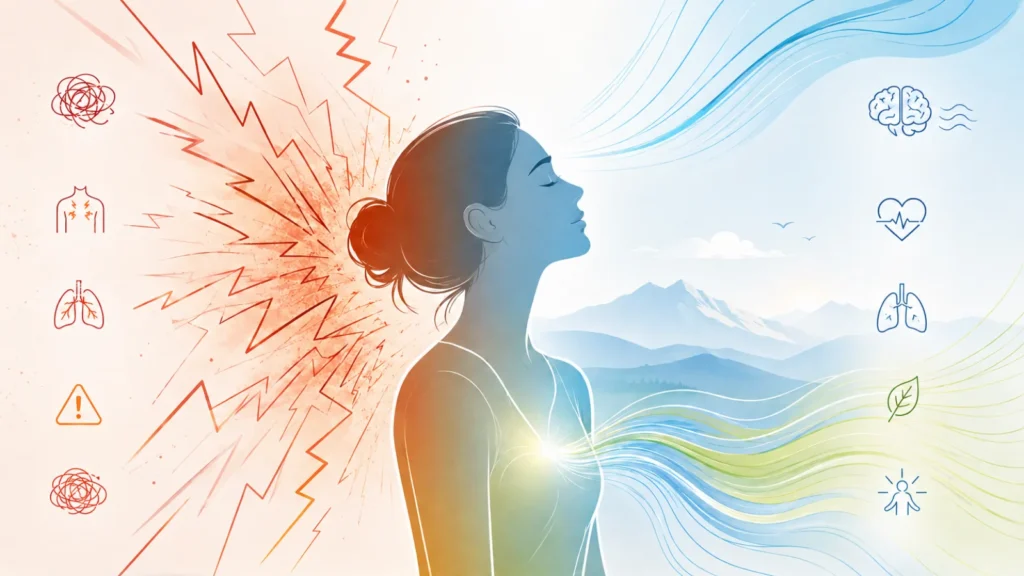
Racing heart. Tight chest. That feeling like the air in the room just got thinner. You're not being dramatic, and you're not broken. Your nervous system is doing exactly what it's built to do — it's just aiming a fire hose at a paper cut.
Here's what's actually happening under your hood, and what genuinely helps it settle — no medication required and no more willpower than you've already got.
Serving Utah County and Salt Lake County · American Fork, Utah
The science bit
What's Actually Happening in Your Body
According to Harvard Health Publishing, your body has a built-in alarm system called the fight-or-flight response, and it does not know the difference between a bear and an unread email. When your brain perceives a threat — real or not — it floods your system with stress hormones like adrenaline and cortisol. Heart rate climbs. Breathing goes shallow and fast. Muscles tense up, ready to fight or flee something that, most of the time, is actually just an email.
That alarm system can't tell a genuine emergency from a tense meeting, a midnight doom-scroll, or a memory from six years ago that decided to resurface uninvited. It just reacts. So when you feel anxious, your body isn't malfunctioning. It's just really, really committed to a job nobody asked it to do this hard.
Why willpower doesn't cut it
Why "Just Calm Down" Doesn't Work
Here's the part that trips people up: the fight-or-flight response runs on your autonomic nervous system — "autonomic" meaning automatic, meaning you don't get a vote. Telling yourself to relax while your body's mid-alarm is like yelling at a smoke detector to knock it off. The detector isn't listening to you. It's listening to the smoke.
That's not you doing it wrong. It just means the fix isn't more willpower — it's giving your nervous system a different signal, one that actually reaches whatever's holding the alarm button down.
"I think everybody, starting from a very young age and until really, until our last days of life, could benefit from having tools that allow us to push back on that stress response."
— Andrew Huberman, PhD, Stanford neurobiologist
Getting back to baseline
How Your Nervous System Finds Its Way Back to Calm
Good news: the alarm has an off switch. The parasympathetic "rest and digest" state is fight-or-flight's calmer sibling, and it runs largely through the vagus nerve. Anything that genuinely flips that switch helps your body downshift — slow, deep breathing, cold water on your face, movement, time outside, a few minutes with a person who makes you feel safe instead of on guard.
"It increases something called parasympathetic tone, which is telling your body the opposite of fight or flight... Things are OK, we're safe. Let's calm down."
— Dr. Daniel Amen, psychiatrist, founder of Amen Clinics
Six ways to help your body downshift
Slow, deep breathing
The exhale is what actually reaches the vagus nerve — try in for 4 counts, out for 6-8, for a couple of minutes.
Cold exposure
Cold water on your face or wrists taps into a reflex built to slow your heart rate fast. A cold, wet washcloth works as well as an ice bath.
Movement
Stress hormones are meant to get burned off by the fight or flight they're preparing you for. A walk, or just shaking out your hands and shoulders, gives your body a way to complete that cycle.
Time in nature
Even a few minutes outside, away from screens, gives your nervous system a break from constantly scanning for threats.
Safe connection
Nervous systems regulate each other. Sitting near someone calm, or talking to a person you trust, can help yours borrow some of that calm — sometimes called co-regulation.
Wrist pressure point
On the palm side of your wrist, right at the crease on your pinky side, sits a point acupuncturists call Heart 7, or "Spirit Gate." Traditional Chinese Medicine and reflexology both use it for calming the mind — try firm, circular pressure for 15-30 seconds on each side.
Individual experiences and results vary.
Winging it in the moment works, sometimes. Having a plan works more often. Our free 5-Minute Nervous System Reset guide walks through a few of those tools, and our nervous system regulation page goes deeper into why this matters beyond just anxiety.
These tools genuinely help, and stacking a few of them into your day can shift a lot. But if anxiety is still running the show most days despite consistently trying, that's not a sign you're doing something wrong — it's a sign your nervous system might need more support than self-directed tools alone, whether that looks like talk therapy, medical care, or nervous system regulation work like microcurrent neurofeedback.
Where we come in
Where Microcurrent Neurofeedback Fits In
Breathwork and grounding tools are a fire extinguisher — great to have, aimed at whatever's burning right now. Microcurrent neurofeedback is aimed at something different: not putting out today's fire, but helping your nervous system stop lighting so many of them in the first place.
Sessions are about as low-key as wellness gets: no screens, no active task, just relaxing in a chair while gentle microcurrent stimulation pairs with your brain's own electrical activity. Many clients report feeling calmer and more settled afterward, often alongside whatever else they're already doing — talk therapy, medication, or their own regulation practices. Individual experiences vary, and this isn't a substitute for mental health treatment.
If anxiety specifically is what brought you here, our dedicated anxiety support page goes deeper into what working with us actually looks like.
Not ready to commit to a full plan?
Start With The Rapid Reset Session: $85
A trimmed-down intro session built around one thing: helping your nervous system find calm, before you commit to anything more. 15-20 minutes total, new clients only. It's the fastest way to find out if this is right for you.
Book The Rapid Reset →Common questions
Frequently Asked Questions
Free 30-minute consultation
Ready to Turn the Alarm Down?
If anxiety's been running your life like an over-caffeinated stage manager, a free consultation is a low-pressure way to figure out what's actually going on — and whether microcurrent neurofeedback makes sense for you.
No pressure. No referral needed. Flexible scheduling including evenings and Saturdays.
Clear Mind Utah · 21 E. 100 N., Ste. 101, American Fork, Utah · (385) 304-4434
Individual experiences vary. This technique is offered as general self-care information and is not a substitute for medical or mental health treatment. Clear Mind Utah provides microcurrent neurofeedback as a wellness and nervous system support service. We do not diagnose, treat, or cure any medical or mental health condition. If you are experiencing a mental health crisis, please contact a qualified professional or call or text 988 to reach the Suicide and Crisis Lifeline.
Where to go from here
Who This Helps, and What to Explore Next
This tends to resonate most with people who've already tried the usual advice — more sleep, more exercise, "just relax" — and are still stuck in a nervous system that won't settle. If that's you, here's where to keep exploring.

About the Author
Troy Gundersen
Troy is the co-founder and owner of Clear Mind Utah, a family-owned microcurrent neurofeedback center in American Fork, Utah. He and his wife Valerie opened the center after experiencing firsthand how a stuck nervous system can quietly take over, and how much is possible when it finally shifts. Troy works alongside Val and their daughter Sydni to help adults and families across Utah County find their way back to calm. Learn more about the team →