
Two Terms People Mix Up
Neurofeedback vs.
Biofeedback:
What's the Difference?
The two terms get used interchangeably online, and that's genuinely confusing — they're related, but they're not the same thing. One is a broad category. The other is a specific, brain-focused type inside that category.
Here's what each one actually measures, what they're typically used for, and how to tell which one a given concern actually calls for.
Serving Utah County and Salt Lake County · American Fork, Utah
The broader category
What Is Biofeedback?
According to the Cleveland Clinic, biofeedback is a broad, non-invasive approach that helps people learn to influence certain involuntary bodily functions — things you don't normally consciously control. Sensors track a physiological signal in real time and feed it back to you (often as a sound, number, or visual), so you can practice actually changing it.
Common biofeedback modalities measure things like heart rate, muscle tension, skin temperature, breathing patterns, and skin conductance (a marker of stress response). It's used for a wide range of physical and stress-related concerns — chronic pain, tension headaches, high blood pressure, and general stress management, among others.
The brain-specific type
What Is Neurofeedback?
Neurofeedback is a specific type of biofeedback — not a separate, competing category. Instead of tracking things like heart rate or muscle tension, it tracks brainwave activity directly, typically using EEG (electroencephalography) sensors placed on the scalp.
Because it's working with brain activity specifically, neurofeedback is the form most often used for concerns tied to how the brain regulates itself — focus and attention, emotional regulation, sleep patterns, and the nervous system's overall ability to shift between "on alert" and "at rest." Clear Mind Utah's own approach, IASIS Microcurrent Neurofeedback, falls into this category.
The mechanism
How Does Neurofeedback Training Actually Work?
In general EEG-based neurofeedback, sensors placed on the scalp read brainwave activity in real time. That activity gets reflected back to you — often as a changing sound, or as a visual cue like a video that only plays smoothly when the brain produces certain patterns. Over repeated sessions, this feedback loop gives the brain a chance to recognize and reinforce more balanced patterns on its own, sometimes described as training rather than treatment, since the brain is doing the adjusting, not an outside device.
IASIS Microcurrent Neurofeedback — the specific approach used at Clear Mind Utah — works a little differently. Instead of asking you to actively watch a screen or complete a task, it takes a passive approach: gentle microcurrent stimulation paired with your own brain's electrical activity, while you simply relax in a chair. No screens, no active participation required.
"Neurons that fire together, wire together."
— Carla Shatz, neuroscientist, popularizing Donald Hebb's 1949 theory of neural connection
Side by side
Key Differences
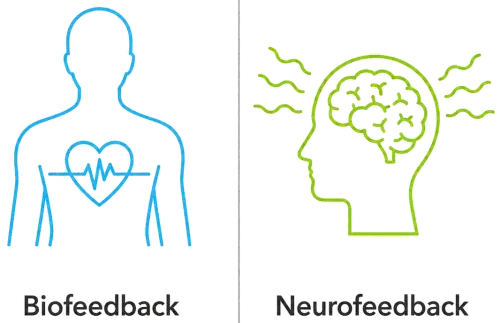
| Biofeedback | Neurofeedback | |
|---|---|---|
| What it measures | Body-wide signals: heart rate, muscle tension, skin temperature, breathing | Brainwave activity specifically, via EEG |
| Common uses | Chronic pain, tension headaches, blood pressure, general stress | Focus, emotional regulation, sleep, nervous system regulation |
| Sensor placement | Fingers, chest, or skin | Scalp |

Biofeedback
- ●Feels like watching a real-time readout of your own body and learning to consciously influence it
- ●Best suited for physical patterns you want more direct control over
- ●Can range from simple wearables to full clinic-based sessions
Neurofeedback
- ●A more passive process — especially with approaches like IASIS, your brain gets the feedback without you having to actively do anything
- ●Best suited for patterns tied to how your brain regulates focus, mood, or sleep
- ●Typically requires a trained, certified practitioner rather than a general wellness device
The simplest way to remember it: every neurofeedback session is a biofeedback session, but not every biofeedback session is neurofeedback. It's a subset, not a rival.

Which one do you need
Which One Fits Your Concern?
If what you're dealing with is mostly physical — tension, pain, blood pressure, general stress in the body — general biofeedback modalities are often the more direct fit.
If what you're dealing with is more about how your brain and nervous system regulate themselves — trouble focusing, a mind that won't settle, sleep that doesn't restore you, emotional reactivity that feels bigger than the situation — that's the territory neurofeedback specifically addresses, since it's working with brain activity directly rather than a downstream physical symptom of it.
At Clear Mind Utah, we specialize specifically in IASIS Microcurrent Neurofeedback — a gentle, passive approach aimed at supporting the brain and nervous system's own ability to self-regulate. Sessions use small scalp sensors, last roughly 20-30 minutes, and require no screens or active concentration on your part.
Common reasons people look into it
What People Explore Neurofeedback For
Neurofeedback is still an evolving field, and it isn't a universal fix — but it's commonly explored, often alongside other care, for concerns like:
Focus and Attention
Concerns around distractibility and staying on task, including for kids and teens.
Anxiety and Mood
A nervous system that feels stuck in overdrive, often explored alongside talk therapy or medication.
Sleep
Support for a nervous system that has trouble winding down at night.
Trauma and Stress Response
Support for a nervous system shaped by big-T or little-t trauma, big or small.
Everyday Mental Clarity
Used by some with no specific concern, just wanting more consistent focus and calm.
Not everyone needs a certified specialist for general biofeedback, but for anything brain-specific, working with practitioners who are actually trained and certified in neurofeedback matters — it's a real skill, not a one-size-fits-all device.
Common questions
Frequently Asked Questions
Free 30-minute consultation
Curious Which Approach Fits You?
If you're not sure whether your concern is more physical or more brain-based, that's exactly the kind of question a free consultation can help sort out — no pressure, no referral needed.
No pressure. No referral needed. Flexible scheduling including evenings and Saturdays.
Clear Mind Utah · 21 E. 100 N., Ste. 101, American Fork, Utah · (385) 304-4434
Individual experiences vary. This technique is offered as general self-care information and is not a substitute for medical or mental health treatment. Clear Mind Utah provides microcurrent neurofeedback as a wellness and nervous system support service. We do not diagnose, treat, or cure any medical or mental health condition. If you are experiencing a mental health crisis, please contact a qualified professional or call or text 988 to reach the Suicide and Crisis Lifeline.

About the Author
Troy Gundersen
Troy is the co-founder and owner of Clear Mind Utah, a family-owned microcurrent neurofeedback center in American Fork, Utah. He and his wife Valerie opened the center after experiencing firsthand how a stuck nervous system can quietly take over, and how much is possible when it finally shifts. Troy works alongside Val and their daughter Sydni to help adults and families across Utah County find their way back to calm. Learn more about the team →