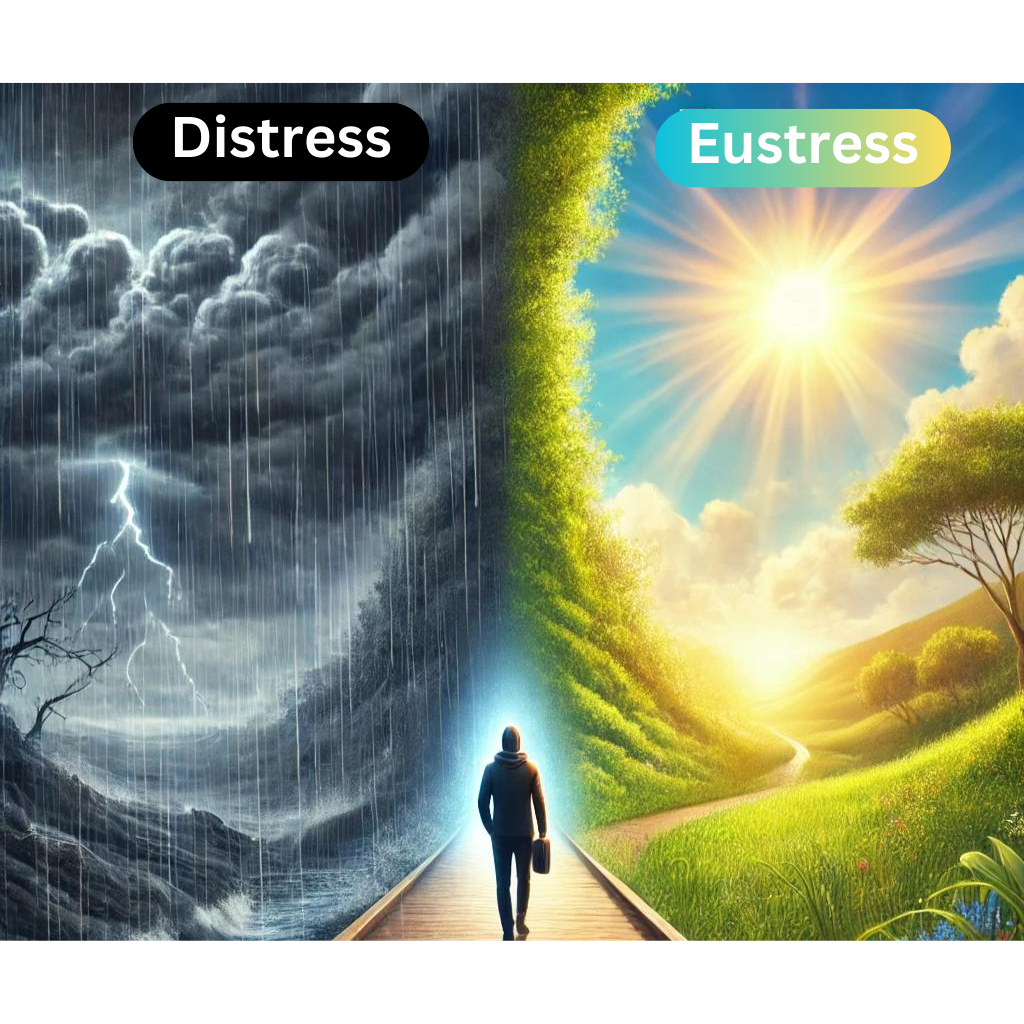
Eustress is the kind of stress that helps you — it shows up as excitement before a challenge, motivation before a deadline, energy before a big moment. Distress is the opposite: the kind that wears you down, leaves you foggy, and makes everyday demands feel impossible. Same nervous system, two very different experiences.
Quick answer: Eustress is stress that helps you — short bursts of excitement or focus. Distress is stress that hurts you — the kind that lingers and wears you down. The difference isn’t the stressor itself, it’s how your nervous system responds to it.
Most people only ever hear the word “stress” used one way — as something to get rid of. But your body doesn’t actually work that way. The World Health Organization estimates that 359 million people worldwide were living with an anxiety disorder as of 2021, and part of what keeps that number climbing is that almost nobody’s ever taught the difference between the stress that pushes them forward and the stress that’s quietly wearing them down.
Once you can tell eustress and distress apart, you have something to actually work with — for yourself, and if you’re supporting someone else through it too.
What Is Eustress?
Short-term, manageable stress that leaves you sharper instead of drained. Think of the nerves before walking on stage, the rush of a first date, or the focus right before a big presentation. Your heart rate goes up, your senses sharpen — and afterward, you feel accomplished instead of depleted.
What Is Distress?
Stress that overstays its welcome. It’s the kind that doesn’t resolve — a demanding job with no end in sight, a relationship that keeps you on edge, a body that won’t fully relax even when nothing’s actively wrong. Distress drains you rather than sharpens you, and left unmanaged, it starts showing up in your body as much as your mind.
Eustress vs Distress: The Key Differences
Side by side, the differences are easier to spot than you’d think:
| Eustress | Distress | |
|---|---|---|
| Duration | Short-lived | Tends to linger |
| Afterward | Energized | Depleted |
| Sense of control | “I can handle this” | “I can’t handle this” |
| Physical impact | Passes through the body | Settles in — cortisol, tension, poor sleep |
| Motivation | Fuels it | Erodes it |
Why the Difference Actually Matters
When distress goes unmanaged long enough, it doesn’t stay in your head — it shows up in your body. Chronic distress is linked to elevated cortisol, which over time can affect your heart, your immune system, and your weight. It also tends to crowd out eustress entirely: when you’re stuck in distress, it’s hard to feel motivated or resilient about anything, even things you’d normally enjoy.
Distress builds, resilience shrinks, and the next stressful thing feels even harder than the last one.
Understanding the eustress vs distress divide is the first step out of that loop, because it gives you something concrete to work toward instead of just “less stress” in the abstract.
How Microcurrent Neurofeedback Fits In
Microcurrent neurofeedback is a gentle, non-invasive approach that supports your brain in shifting out of the high-beta brainwave patterns often associated with chronic distress. It isn’t designed to target any single diagnosis — it works with your nervous system’s own patterns, and many clients notice a shift in related symptoms as those patterns settle.
Research note: A 2020 study in The Journal of Neurotherapy found that neurofeedback was associated with reduced anxiety through changes in brainwave patterns (source).
Separately, Harvard Medical School has written about how neuroplasticity — your brain’s ability to form new patterns — plays a central role in building a healthier stress response over time (source).
The goal isn’t to eliminate stress. It’s to help your nervous system spend less time stuck in distress, so there’s more room for the kind of stress that actually moves you forward.
How to Shift From Distress Toward Eustress
You can’t eliminate stress, and you probably don’t want to — some stress is exactly what gets you out the door and into the life you want. What you can do is get better at moving out of distress and into eustress when you notice you’re stuck.
Track Your Distress Triggers
Keep a simple stress journal for a couple of weeks. After a stressful moment, jot down what happened and how your body reacted. Patterns show up fast — certain people, certain times of day, certain kinds of tasks. Once you can see the pattern, you can plan around it instead of just reacting to it.
Reframe the Challenge
Ask yourself what you could learn from a hard situation, or how it might make you stronger. This isn’t about pretending something difficult is fine — it’s about giving your brain a second option besides “this is bad,” which is often enough to nudge a distress response toward a eustress one.
Use Mindfulness to Interrupt the Spiral
A few minutes of slow breathing or a body scan can pull you out of a distress spiral before it fully takes hold. Apps like Calm, Headspace, or Insight Timer make this easy to build into a normal day.
Move Your Body
Exercise is one of the most consistent ways to shift your stress response — even a 15–20 minute walk can reset a stressful afternoon. Research from the American Psychological Association backs this up.
Set Real Boundaries
Chronic distress often comes from overcommitment. Saying no, protecting downtime, and stepping back from constant notifications all give your nervous system room to recover instead of staying switched on.
Build Supportive Relationships
Who you spend time with matters more than most people give it credit for. Supportive people help pull you toward eustress; draining ones tend to keep you stuck in distress.
Practice a Growth Mindset
Treating setbacks as information instead of failure changes how your body responds to the next hard thing. It’s less about being naturally resilient and more about practicing the response until it becomes normal.
FAQs About Eustress vs Distress and Microcurrent Neurofeedback
Bringing It Back Together
Eustress and distress aren’t opposites you’re supposed to pick between — they’re both part of a normal stress response. The goal isn’t a stress-free life; it’s a nervous system that can tell the difference and move through distress instead of getting stuck there.
If that’s something you’re ready to work on, our team at Clear Mind Utah can help.
Where to go from here
Who This Helps, and What to Explore Next
This one’s for anyone who’s been told to “just relax” and found that useless — if you can tell you’re stressed but can’t tell whether it’s helping or hurting you, start here.

About the Author
Troy Gundersen
Troy is the co-founder and owner of Clear Mind Utah, a family-owned microcurrent neurofeedback center in American Fork, Utah. He and his wife Valerie opened the center after experiencing firsthand how a stuck nervous system can quietly take over, and how much is possible when it finally shifts. Troy works alongside Val and their daughter Sydni to help adults and families across Utah County find their way back to calm. Learn more about the team →
Clear Mind Utah · 21 E. 100 N., Ste. 101, American Fork, Utah · (385) 304-4434
Individual experiences vary. This technique is offered as general self-care information and is not a substitute for medical or mental health treatment. Clear Mind Utah provides microcurrent neurofeedback as a wellness and nervous system support service. We do not diagnose, treat, or cure any medical or mental health condition. If you are experiencing a mental health crisis, please contact a qualified professional or call or text 988 to reach the Suicide and Crisis Lifeline.