Understanding Your Vagus Nerve
Your Body Has an
Off Switch.
It's Called the
Vagus Nerve.
You've probably heard the term by now — it's everywhere. For once, the hype is pointing at something real: a nerve that runs through your whole body and plays a direct role in how calm or wired you feel.
Here's what it actually is, why it matters, and simple ways to activate it — starting today, no equipment required.
Serving Utah County and Salt Lake County · American Fork, Utah
The basics
What Is the Vagus Nerve, Actually?
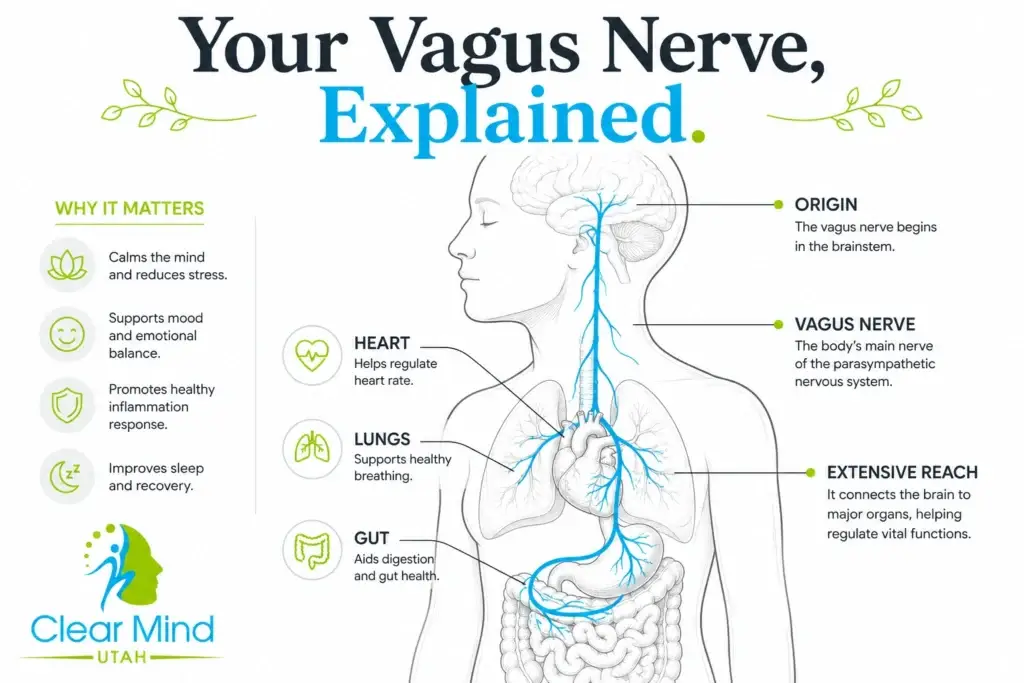
The vagus nerve is the longest nerve in your autonomic nervous system, running from your brainstem down through your neck, chest, and abdomen — touching your heart, lungs, and gut along the way. "Vagus" is Latin for "wandering," which is exactly what it does: it's the main line connecting your brain to nearly every organ involved in how calm or wired you feel.
It's also the primary channel for your parasympathetic nervous system — the "rest and digest" side of things, as opposed to the "fight or flight" sympathetic side most people already know. When people talk about "activating the vagus nerve," they're really talking about strengthening the signal that tells your body it's safe to stand down.
Fight or flight
Rest and digest
Researchers call this vagal tone — how efficiently your body shifts between these two states. Higher vagal tone is associated with steadier mood and a nervous system that doesn't stay stuck in high alert as often. The good news: vagal tone isn't fixed. It responds to what you do, in real time.
The bigger picture
Why This One Nerve Gets So Much Attention
The vagus nerve's reach goes further than the calm-in-the-moment techniques most people hear about. It's also the main line of communication between your brain and your gut — a genuine two-way channel. According to the Cleveland Clinic, signals travel down to help manage digestion, and signals travel back up that shape mood and how you perceive stress. It's part of why a "gut feeling" isn't just a figure of speech.
There's also a real, less-talked-about connection to inflammation. The vagus nerve's primary chemical messenger, acetylcholine, plays a role in keeping inflammatory signals in the body in check — part of what researchers call the cholinergic anti-inflammatory pathway. It's an active area of ongoing research, not settled science, but it's a serious reason this nerve gets studied well beyond the stress-and-anxiety conversation.
A measurable marker
Harvard Health Publishing points to heart rate variability — the tiny variation in time between heartbeats — as a direct, measurable marker of vagal tone. Their finding: just five to ten minutes of deep breathing a day is enough to measurably shift it. This isn't a vague wellness claim; it's something that shows up on an actual heart rate monitor.
There's also a separate, more clinical side to this story: vagus nerve stimulation, which uses an implanted medical device rather than any of the self-directed techniques below. Per the Cleveland Clinic, it's an FDA-approved option for difficult-to-control epilepsy and depression, and is being researched further for a handful of other hard-to-treat conditions. That's a distinct medical path from what's covered on this page — but it's a good example of just how seriously this one nerve gets taken in modern medicine.
Does this sound familiar?
Signs Your Vagal Tone Might Be Running Low
Low vagal tone doesn't announce itself with one obvious symptom — it shows up as a pattern across your body and your mood. Here's what that pattern often looks like:
In your body
In your mind and mood
If a lot of this sounds familiar, you're not imagining it. This is exactly the territory nervous system dysregulation covers in more depth, and it overlaps heavily with what we see on our anxiety support page too.
Try it today
How to Activate Your Vagus Nerve
None of these need equipment, an app, or a quiet room. They work through the same channel, just from a few different angles — and if you want more breathing-specific techniques beyond what's here, our guide to calming your nervous system for stress relief goes deeper on that side of things.
The long exhale
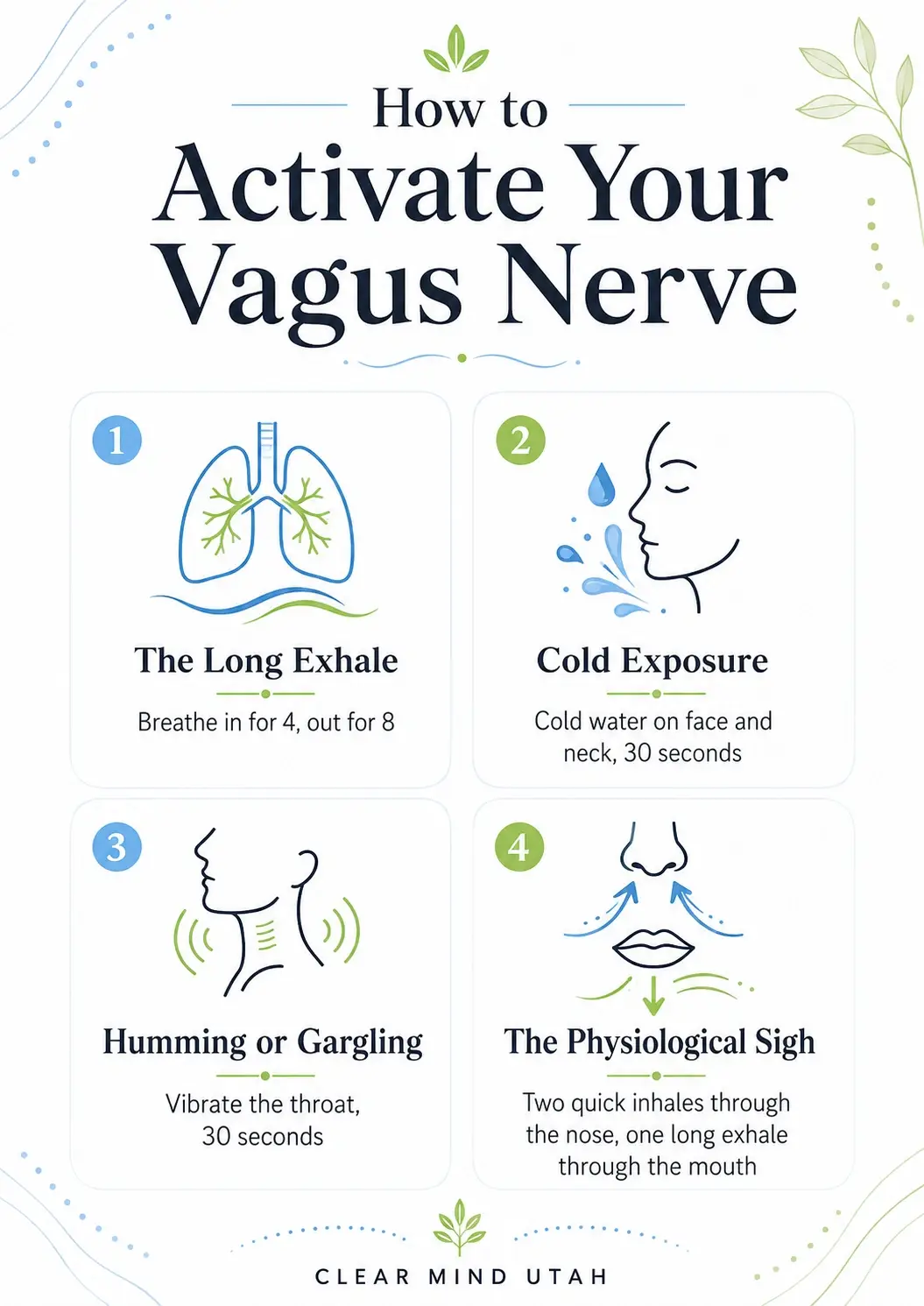
Breathe in for a count of four, out for a count of eight. Inhaling gives your sympathetic system a brief, natural boost; exhaling reactivates the parasympathetic side. Stretch the exhale out longer than the inhale, and you stretch that calming signal out with it. Try five or six rounds — breathe in through the nose, out slowly through pursed lips, like you're gently blowing through a straw. Most people notice a shift within the first minute.
Cold exposure
Splash cold water on your face, or hold a cold pack against your cheeks and neck for 30 seconds. Cold on the face fires the trigeminal nerve, which runs straight to your brainstem and triggers the vagus nerve — the mammalian dive reflex, the same one that kicks in when your face hits cold water.
One caution worth knowing: this is generally well tolerated, but if you have a heart condition, are pregnant, or have Raynaud's, check with a doctor before trying it — cold exposure can occasionally trigger a stronger drop in heart rate than intended.
Humming or gargling
The vagus nerve runs directly through your throat. Humming vibrates it right where it passes through your larynx. Gargling water — hard enough that your eyes water slightly — hits the same pathway harder and faster. Try holding a hum for the length of one full exhale, repeated five or six times. If gargling feels like too much, humming alone gets you most of the same effect, just more gently.
The physiological sigh
Two inhales through your nose, back to back, followed by one long exhale through your mouth. A 2023 Stanford study found this specific pattern outperformed meditation and other breathing styles for easing momentary stress, even done just once or twice. Two or three rounds back to back gives the strongest effect — and it doesn't need to be done perfectly to work.

Common questions
Frequently Asked Questions
These techniques are genuinely useful for day-to-day regulation — free, fast, and they work. But they have a real ceiling. If your nervous system has been running in overdrive for a long time, self-directed tools can help you cope with it without necessarily shifting the underlying pattern. That's where microcurrent neurofeedback comes in — many clients tell us it helped move things in a way daily techniques alone hadn't. If breathwork and cold splashes have become a daily necessity rather than an occasional reset, that's worth a conversation, not a diagnosis.
Want a few of these techniques in your back pocket for the next time anxiety spikes? Grab our free guide, The 5-Minute Nervous System Reset.
Free 30-minute consultation
Ready to Help Your Nervous System Find Calm?
Whenever you feel ready, you don't have to face this alone. At Clear Mind Utah, we're here to listen, answer your questions, and help you decide if neurofeedback is the right next step for you or your family.
No pressure. No referral needed. Flexible scheduling including evenings and Saturdays.
Clear Mind Utah · 21 E. 100 N., Ste. 101, American Fork, Utah · (385) 304-4434
Individual experiences vary. This technique is offered as general self-care information and is not a substitute for medical or mental health treatment. Clear Mind Utah provides microcurrent neurofeedback as a wellness and nervous system support service. We do not diagnose, treat, or cure any medical or mental health condition. If you are experiencing a mental health crisis, please contact a qualified professional or call or text 988 to reach the Suicide and Crisis Lifeline.

About the Author
Troy Gundersen
Troy is the co-founder and owner of Clear Mind Utah, a family-owned microcurrent neurofeedback center in American Fork, Utah. He and his wife Valerie opened the center after experiencing firsthand how a stuck nervous system can quietly take over, and how much is possible when it finally shifts. Troy works alongside Val and their daughter Sydni to help adults and families across Utah County find their way back to calm. Learn more about the team →