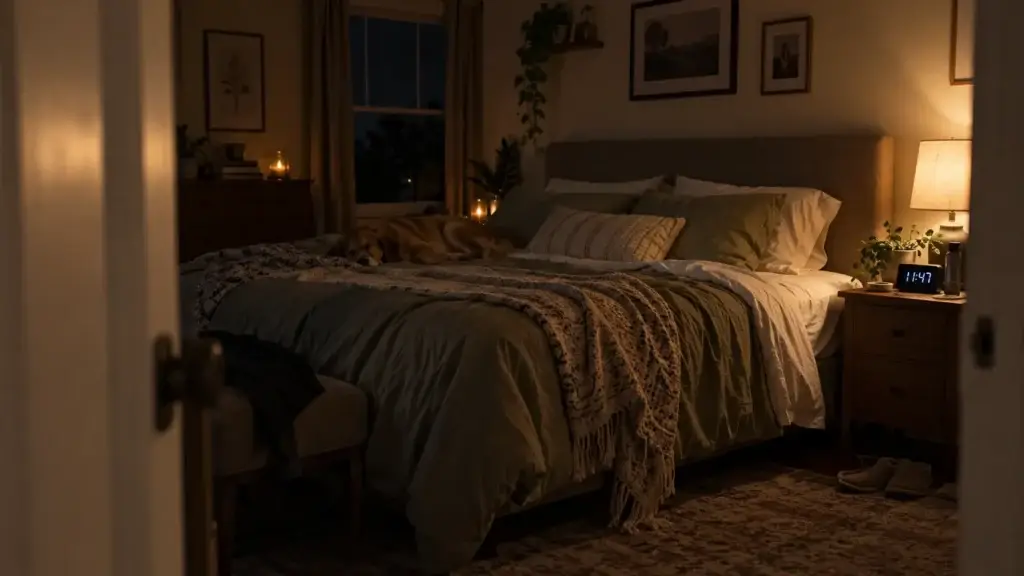
A quiet nighttime bedroom with a bedside clock showing a late hour | clear mind utah

For parents (and everyone else)

Is Sleep Before Midnight Actually Better?

Your kid's up until 11:30 again. They're napping mid-afternoon, dragging through homework, and somehow still wired and anxious by dinner. You've heard the advice a hundred times: get them to bed before midnight, as if their pillow turns into a pumpkin at 12:01. But does the clock itself actually matter, or is something else going on?

The real science

Midnight Myth vs. What Actually Matters

Here's the honest split, since the popular version of this advice oversimplifies it:

The popular myth

There's something magic about the number 12
Missing that exact hour ruins the night
Night owls are just doing it wrong

What the research shows

Your circadian rhythm matters more than the clock
Night-to-night consistency is the real lever
A sleep midpoint around 1am is linked to better outcomes, regardless of chronotype

“Many of us should go to sleep before midnight, but there's nothing magical about these pre-midnight hours specifically.”

Dr. Chester Wu, MD — double board-certified in Psychiatry and Sleep Medicine, Stanford Sleep Medicine Fellowship

A large study covering nearly 74,000 adults found that people with a sleep midpoint outside the 2am-4am window had meaningfully more depressive symptoms, and night owls who stuck to their natural late schedule were 20-40% more likely to have a diagnosed mental health condition than night owls who shifted earlier. The takeaway isn't "midnight is magic" — it's that earlier, regular bedtimes make it a lot easier to get both consistency and enough total sleep. Your circadian rhythm doesn't care what the clock on the wall says, but it does keep meticulous, judgmental notes on your actual habits.

The weekend problem

Why Weekends Undo the Whole Week

There's a real name for the "sleep in on Saturday, pay for it Monday" pattern: social jetlag, a term coined by chronobiologist Till Roenneberg to describe the mismatch between your body's internal clock and your actual schedule. It's measured by comparing your sleep midpoint (the halfway point between falling asleep and waking up) on work or school days versus free days — the bigger the gap, the bigger the "jetlag."

For a kid who's up late and sleeping in every weekend, that's a genuine timezone shift happening twice a week, without ever leaving the house. No frequent flyer miles, unfortunately. It's a real driver of why "just this once" late nights add up to more disruption than they seem to in the moment.

What's really happening

The Brain's Overnight Cleanup

This is real, published research — not wellness-influencer talk. Researchers at Boston University, led by neuroscientist Laura Lewis, found that cerebrospinal fluid moves through the brain in slow waves during deep sleep, synchronized with brainwave activity — part of what's now called the glymphatic system, believed to clear out waste and toxic proteins as a kind of nightly cleanup, alongside memory consolidation. Think of it less as a magical detox and more like your brain running its own overnight janitorial shift — unglamorous, essential, and not something you can speed up with a supplement.

2019, Boston University

Published in the journal Science — the first study to directly link CSF movement to sleep brainwaves.

4-6 cycles a night

A separate, well-established fact: a typical night moves through about 4-6 complete ~90-minute sleep cycles.

“It's such a dramatic effect — [CSF pulsing during sleep] was something we didn't know happened at all, and now we can just glance at one brain region and immediately have a readout of the brain state someone's in.”

Laura Lewis — study co-author, Boston University College of Engineering

None of this happens properly on 5 broken hours. It needs real, uninterrupted deep sleep — which is exactly what a too-late, inconsistent bedtime cuts into first.

Why it hits kids harder

Kids Need More, and Their Sleep Is Still Developing

Kids and teens need more total sleep than adults, and late nights and inconsistent bedtimes hit them harder than they hit us. A daytime nap might look like the body "catching up," but there's a real mechanism behind why it can backfire: your drive to sleep builds from a substance called adenosine that accumulates the longer you're awake, part of what sleep scientists call the two-process model of sleep regulation. A short nap earlier in the day (roughly 1-3pm, 20-30 minutes) barely touches that buildup. A longer or later nap clears out enough of it that by bedtime, the biological pressure to actually fall asleep just isn't there yet — which can look a lot like "not tired" when it's really "reset the clock." Try explaining sleep pressure to a six-year-old who insists they're not even a little bit sleepy at 9pm. Godspeed.

The daytime anxiousness, the crankiness, the trouble focusing on homework — these are commonly associated with insufficient or fragmented sleep, not necessarily a sign of something else going on. That's not a diagnosis, just a pattern worth paying attention to before assuming it's something more complicated. (And no, "just one more episode" does not count as a wind-down routine, no matter how convincingly it gets argued at 9:47pm.)

A real benchmark

How Much Sleep Kids Actually Need, By Age

Before adjusting a bedtime, it helps to know what the actual target is. These are the official ranges from the American Academy of Sleep Medicine, endorsed by the American Academy of Pediatrics:

4-12 months 12-16 hours per 24 hours
1-2 years 11-14 hours per 24 hours
3-5 years 10-13 hours per 24 hours
6-12 years 9-12 hours per 24 hours
13-18 years 8-10 hours per 24 hours

Source: American Academy of Sleep Medicine, endorsed by the American Academy of Pediatrics. Ranges include naps for younger children.

Practical steps

What Actually Helps
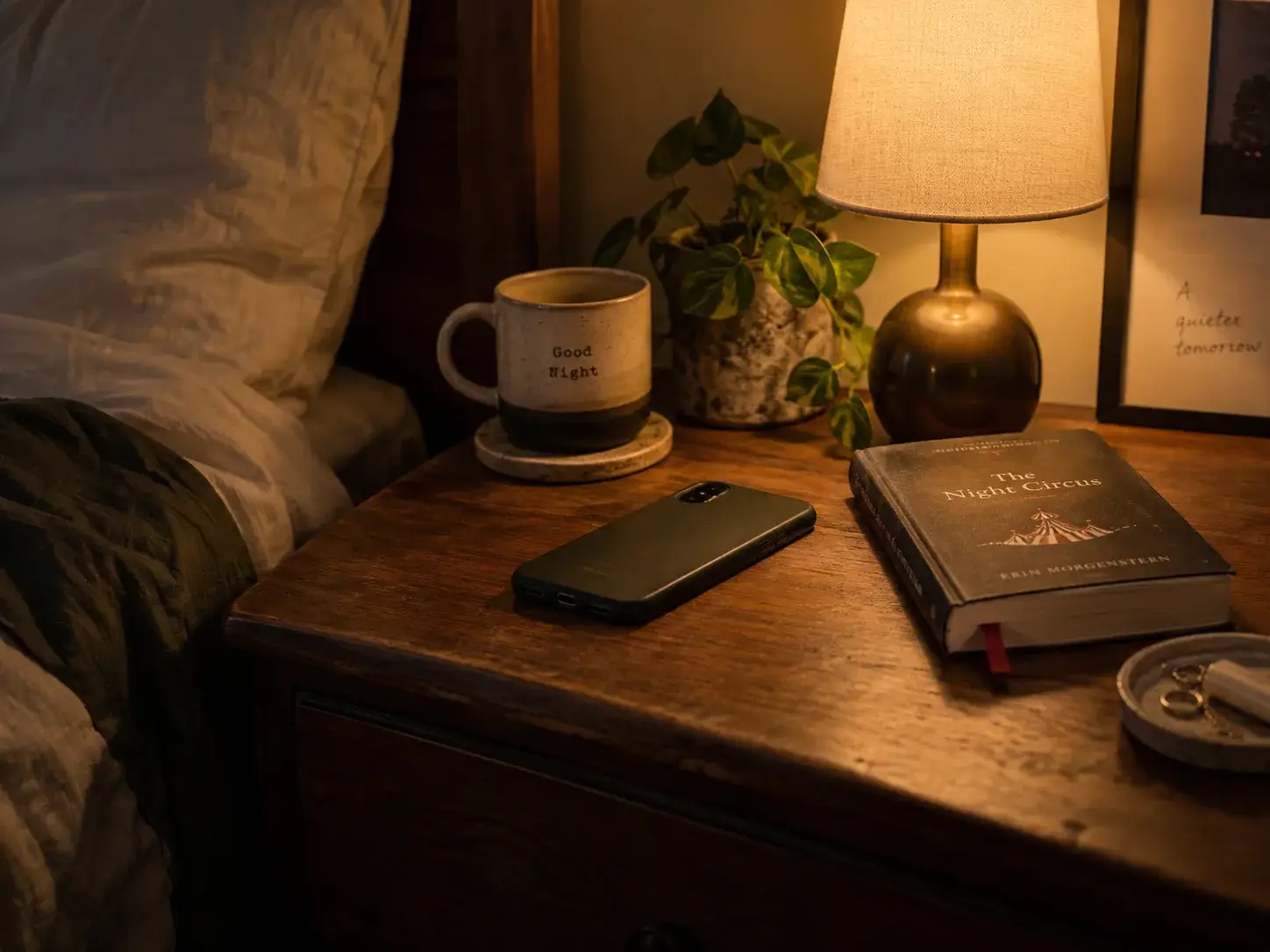
A nightstand at the end of the day with a phone face-down and a dim lamp

Evening: wind down

Soft morning light streaming through a bedroom window onto a made bed

Morning: light early

1

Pick a consistent bedtime and wake time

Even on weekends. Consistency is doing more work here than the exact hour you choose.

2

Get morning light early

Bright light in the first hour of waking helps anchor the whole 24-hour cycle — the same mechanism behind the morning cortisol timing we've written about before.

3

Build a wind-down window

The last 30-60 minutes before bed should be low-stimulation: dim lights, no screens, nothing that revs up the nervous system right before asking it to power down. There's a real reason screens specifically make this harder: light-sensitive cells in the eye detect blue wavelengths and signal the brain's master clock to suppress melatonin, the hormone that helps you feel sleepy. Your phone is, biologically speaking, a tiny sun you're holding six inches from your face at 11pm, and your brain believes it. This is the step everyone already knows and almost nobody actually does.

4

Watch for the 3-3-3 pattern

Poor sleep at least 3 nights a week, for at least 3 months, affecting at least 3 parts of the day (mood, focus, energy) is a common rule doctors use to flag when it's worth a real conversation with a pediatrician, rather than just a habit to adjust at home.

The bigger picture

Where This Fits With Nervous System Work

A nervous system stuck in a stressed, activated state has a much harder time settling into the deep sleep this whole process depends on — which can turn into a loop: poor sleep makes regulation harder, and a dysregulated nervous system makes good sleep harder to get. Practices like NSDR and consistent morning light can help from the outside in. Microcurrent neurofeedback works with a similar underlying idea from a different angle, supporting your nervous system's own ability to shift out of a chronic stress pattern that's been getting in the way of real rest.

Free 30-minute consultation

Ready to Help Your Family Find Better Sleep?

Whether it's just about getting sleep before midnight into a regular rhythm, or something that needs more support, we're here to listen and help you figure out the next step.

No pressure. No referral needed. Flexible scheduling including evenings and Saturdays.

FAQs about sleep timing and the brain

Why is it important to sleep between 10pm and 2am?
This window tends to overlap with when your circadian rhythm naturally pushes you toward deep sleep, and when the cerebrospinal fluid movement linked to brain cleanup and memory consolidation is most active. It's less about those exact clock numbers and more about consistently being asleep during your own body's low point, whatever hours that happens to be for you.
Is 2am too late for bed?
Individual experiences vary, and chronotype (whether you're naturally a night owl or early riser) plays a real role. That said, research on sleep timing has found that a sleep midpoint outside roughly 2am-4am is associated with more depressive symptoms on average, so consistently going to bed well past 2am is worth paying attention to, especially if it's paired with feeling off during the day.
What is the 3-3-3 rule for sleep?
It's an informal screening guideline some doctors use: poor sleep at least 3 nights a week, for at least 3 months, affecting at least 3 areas of your day (like mood, focus, or energy). If that sounds familiar, it's a reasonable signal to bring up with a doctor rather than just something to push through.
How can I improve my glymphatic system?
The research points mainly to getting enough uninterrupted deep sleep on a consistent schedule, since that's when this cerebrospinal fluid movement is most active. There's no supplement or shortcut with strong evidence behind it (sorry) — the sleep itself appears to be the mechanism.
Is it unhealthy for kids to stay up late?
Kids and teens generally need more total sleep than adults, and inconsistent or late bedtimes are commonly associated with daytime crankiness, trouble focusing, and increased anxiousness. This isn't the same as a diagnosis — it's a pattern worth adjusting for at home first, and worth mentioning to a pediatrician if it doesn't improve.
What is the liquid that flushes the brain while sleeping?
Cerebrospinal fluid (CSF) — the same fluid that surrounds and cushions your brain and spinal cord. Research has found it moves in slow waves through the brain during deep sleep, which appears to play a role in clearing waste products and consolidating memory.
Troy Gundersen, IASIS MCN Practitioner at Clear Mind Utah

About the Author

Troy Gundersen

Troy is the co-founder and owner of Clear Mind Utah, a family-owned microcurrent neurofeedback center in American Fork, Utah. He and his wife Valerie opened the center after experiencing firsthand how a stuck nervous system can quietly take over, and how much is possible when it finally shifts. Troy works alongside Val and their daughter Sydni to help adults and families across Utah County find their way back to calm. Learn more about the team →


IASIS MCN Practitioner American Fork, Utah Family-Owned Center

Clear Mind Utah  ·  21 E. 100 N., Ste. 101, American Fork, Utah  ·  (385) 304-4434

Individual experiences vary. This technique is offered as general self-care information and is not a substitute for medical or mental health treatment. Clear Mind Utah provides microcurrent neurofeedback as a wellness and nervous system support service. We do not diagnose, treat, or cure any medical or mental health condition. If you are experiencing a mental health crisis, please contact a qualified professional or call or text 988 to reach the Suicide and Crisis Lifeline.

author avatar
Troy Gundersen

Featured Articles

FREE PDF GUIDE
The 5-Minute Nervous System Reset free guide cover

The 5-Minute Nervous System Reset

Four fast, evidence-informed techniques you can use the moment stress hits — no equipment, no appointment. Get it free, straight to your inbox.

Get the Free Guide →

No spam. Unsubscribe anytime.

BY TROY & VALERIE GUNDERSEN
Overcome Fear book by Troy and Valerie Gundersen

Overcome Fear

Real tools for moving through self-doubt and the fear of the unknown — from the founders of Clear Mind Utah.

Get It on Amazon →
Find-Us-Here.com - the world's largest business and community directory covering Australia, Canada, New Zealand, United Kingdom and United States