Biofeedback in Utah County

Looking for Biofeedback in Utah County? Here's Where Neurofeedback Fits

You searched for biofeedback. Google sent you to a neurofeedback center. Before you hit the back button, hang on a second.

Here's the honest version up front: we don't offer traditional biofeedback. No heart-rate monitors, no muscle sensors, no breathing games. What we offer is microcurrent neurofeedback, which grows on the same family tree, just a couple of branches over.

So this page does two jobs. It shows you how the two compare, so you can pick the one that fits. And if the one that fits isn't us, it shows you how to find a good biofeedback provider instead. Fair deal?

Serving all of Utah County, including American Fork, Lehi, Orem and Provo · American Fork, Utah

The Biofeedback Family Tree

Biofeedback
Muscle tension
Skin temperature
Brain activity
Sweat activity
Heart rate and breathing
Neurofeedback (EEG Biofeedback)

Traditional Neurofeedback

Trains your brain toward a target. You watch the feedback and earn the reward.

What we offer

Microcurrent Neurofeedback

Reads what your brain is doing in the moment and responds. You sit back and rest.

What Is Biofeedback?

Your body is busy doing things you never notice. Your shoulders creep toward your ears while you read a stressful email. Your breathing goes shallow in traffic. Your palms get damp before a hard conversation. Most of it happens below your radar.

Biofeedback puts that stuff on the radar. Sensors pick up what your body is doing and show it to you in real time, so you can learn to change it. Depending on the type, the sensors might track:

  • Muscle tension, with sensors on the skin over the muscle
  • Skin temperature
  • Sweat activity, usually read from your fingertips or palm
  • Heart rate and breathing
  • Brain activity. This one has its own name: EEG biofeedback is also called neurofeedback.

The feedback might be a line on a screen, a tone that rises and falls, music that gets louder or softer, or even a video game. You relax your jaw, slow your breath or drop your shoulders, and you watch the signal answer back. With practice, according to Cleveland Clinic, you can learn to make the same changes without the equipment.

Think of it as a mirror for things you can't normally see. And neurofeedback isn't something separate from biofeedback. It's the branch that works with the brain.

Traditional Biofeedback vs. Microcurrent Neurofeedback

Same family, very different afternoon.

Traditional Biofeedback

What it does
Reads body signals like muscle tension, breathing or heart rate and shows them to you
What you do
You watch the feedback and practice changing it, a bit like learning to steer
What you look at
A screen, a tone or a game that responds to you
Homework
Yes. You practice the skills between sessions
How it feels
Active, like a lesson
The signal
Your body sends it and you read it

Microcurrent Neurofeedback

What it does
Reads your brain's activity in the moment and responds with a very low-level signal
What you do
You sit back and rest. Nothing to practice, nothing to get right
What you look at
Nothing. Close your eyes, or don't
Homework
None. Your homework is to show up
How it feels
Passive and relaxing; many clients describe it as the calmest part of their week
The signal
A very low-level signal, about one-thousandth the voltage of an AA battery. Most clients don't feel anything

Wait, There Are Two Kinds of Neurofeedback?

Yep. Even inside the brain branch, there's a fork in the road.

Traditional neurofeedback trains your brain toward targets a provider picks up front, usually over thirty or forty sessions. Because it's aiming at something, it often starts with a brain map. The feedback rewards your brain each time it hits the target.

Microcurrent neurofeedback doesn't train toward a target. It reads what your nervous system is doing right now, in the moment, and responds to that. So every session responds to the brain you walked in with that day.

Think weather report versus thermostat. One tells you about yesterday. The other responds to the room you're in.

Neither one is "better." They're different tools for different people, and a free consultation is a good place to sort out which one makes sense for you.

Which One Might Fit You?

Traditional Biofeedback May Fit If:

  • You like hands-on learning and want a skill you can use anywhere
  • You're up for practicing between sessions
  • You want to work on something specific in your body, like muscle tension or your breathing

Microcurrent Neurofeedback May Fit If:

  • Your nervous system feels stuck in overdrive: racing thoughts, sleep that never feels like rest, always a little on edge
  • You've been told to "just relax" so many times you could scream
  • Your plate is already full and the last thing you want is more homework

Not sure? That's exactly what the free consultation is for. And if traditional biofeedback turns out to be what you need, the questions a little further down show you how to find a good provider. We'd rather point you in the right direction than sell you the wrong thing.

Neurofeedback vs. biofeedback, in more depth →

What a Microcurrent Neurofeedback Session Looks Like

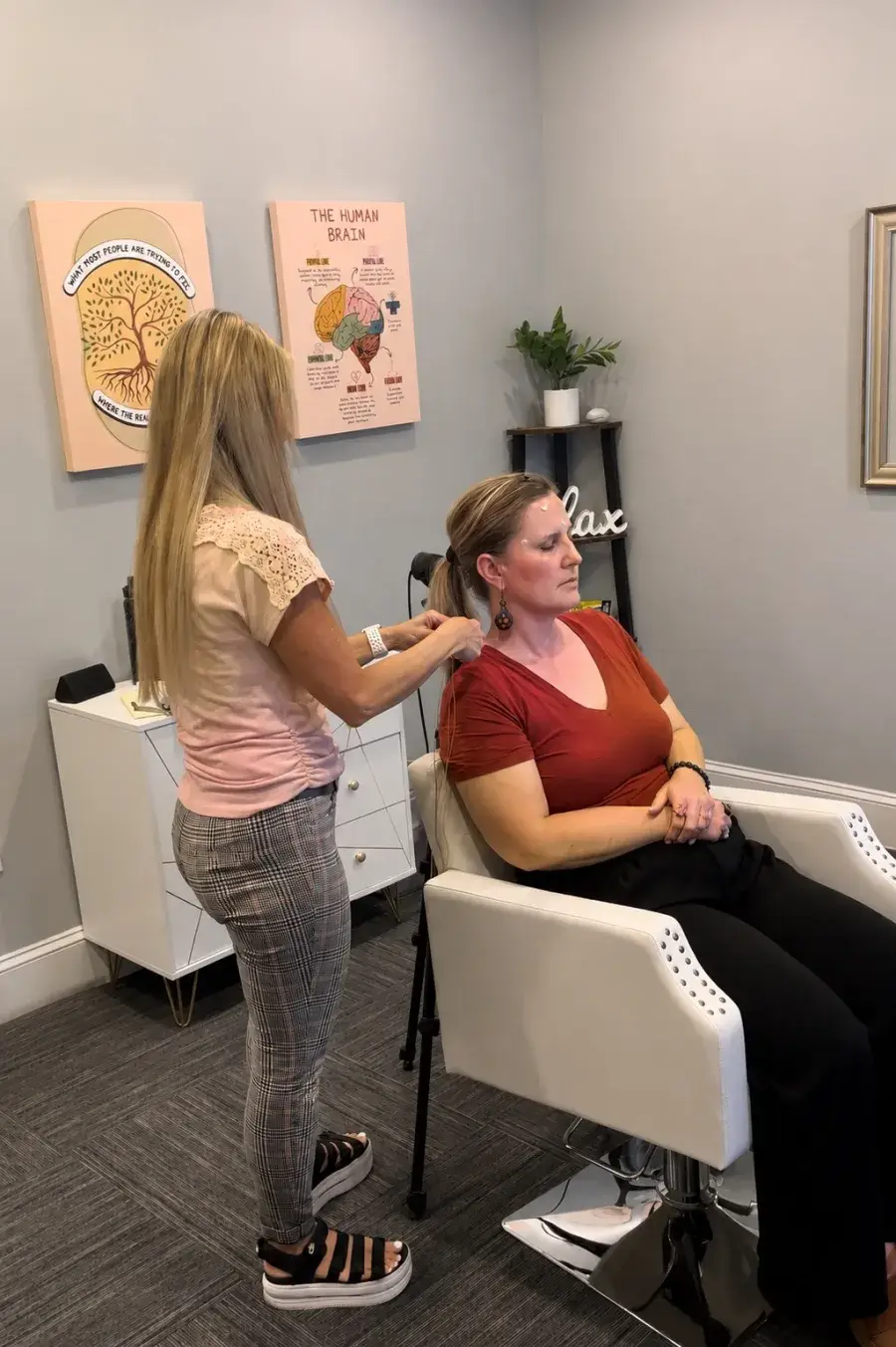
A Clear Mind Utah team member placing small sensors on a client resting in a comfortable chair at our American Fork center

You sit in a comfortable chair. We place a few small sensors on your scalp and ears. You close your eyes, or don't. There's nothing to do, nothing to watch and nothing to get right.

The sensors read what your brain is doing in the moment, and the system answers with a very small, very brief signal. Most clients don't feel anything during a session. Some feel tired or unusually relaxed afterward, and that usually passes within a few hours.

Over a series of sessions, many clients notice they feel calmer, sleep easier or think more clearly. Individual experiences vary. And one session is a sample, not a test: what you notice after the first one often fades within hours to a day or two, which is why we talk about a series instead of a single visit.

We offer evening and Saturday appointments, too.

How microcurrent neurofeedback works →

Shopping for Traditional Biofeedback? Ask These Four Questions

If traditional biofeedback sounds like your thing, great. Here's how to shop for it like someone who's done this before:

  1. Are you certified? Cleveland Clinic recommends checking a provider's credentials before you start. The Biofeedback Certification International Alliance (BCIA) keeps a directory of certified practitioners.
  2. Which type of biofeedback do you use, and why that one for me? Muscle, heart rate, breathing, skin or EEG. A good provider has a reason, not just a favorite gadget.
  3. What's the homework? Traditional biofeedback asks you to practice between sessions, so find out how much and how often.
  4. How many sessions do you expect, and what does the whole thing cost? The per-session price is only half the story.

For the record, we're happy to answer all four about our own work. Ask us on the consult.

Where to Find Us

We're at 21 E. 100 N., Ste. 101, in American Fork, in the north end of Utah County. Clients come from all over the county; see how close we are from Orem and Provo, or from the Salt Lake Valley.

Frequently Asked Questions

Is neurofeedback a type of biofeedback?
Yes. EEG biofeedback is also called neurofeedback: it's the branch of biofeedback that works with brain activity. Microcurrent neurofeedback is a passive approach within neurofeedback: instead of practicing with the feedback, you rest while a very low-level signal is used.
Do you offer traditional biofeedback?
No. We offer microcurrent neurofeedback only. If you're looking for muscle, temperature or heart-rate biofeedback, the four questions above help you find a certified provider, or you can talk it through with us on a free consultation.
Which one is better?
Neither. They're different tools. Traditional biofeedback teaches you a skill you practice; microcurrent neurofeedback is passive and focuses on supporting the nervous system. The right one depends on what you're looking for.
Where are you located?
American Fork, at 21 E. 100 N., Ste. 101. We see clients from across Utah County and the Salt Lake Valley, with evening and Saturday appointments available.
Does it hurt?
No. Most clients don't feel anything during a session. The signal is very low-level, about one-thousandth the voltage of an AA battery.
Is the free consultation really free?
Yes. It's a 30-minute conversation, it costs nothing, and there's no pressure to book anything afterward.
How much does it cost?
A single session is $150, and packages bring the per-session price down to as low as $100. See current pricing.

Not Sure Which One Fits? Let's Talk It Through

Book a free 30-minute consultation. Tell us what's going on, ask us anything on this page, and get a straight answer on whether microcurrent neurofeedback, traditional biofeedback or something else is the right fit.

Clear Mind Utah  ·  21 E. 100 N., Ste. 101, American Fork, Utah  ·  (385) 304-4434

Individual experiences vary. This technique is offered as general self-care information and is not a substitute for medical or mental health treatment. Clear Mind Utah provides microcurrent neurofeedback as a wellness and nervous system support service. We do not diagnose, treat, or cure any medical or mental health condition. If you are experiencing a mental health crisis, please contact a qualified professional or call or text 988 to reach the Suicide and Crisis Lifeline.

Troy Gundersen, IASIS MCN Practitioner at Clear Mind Utah

About the Author

Troy Gundersen

Troy is the co-founder and owner of Clear Mind Utah, a family-owned microcurrent neurofeedback center in American Fork, Utah. He and his wife Valerie opened the center after experiencing firsthand how a stuck nervous system can quietly take over, and how much is possible when it finally shifts. Troy works alongside Val and their daughter Sydni to help adults and families across Utah County find their way back to calm. Learn more about the team →

IASIS MCN Practitioner American Fork, Utah Family-Owned Center
Find-Us-Here.com - the world's largest business and community directory covering Australia, Canada, New Zealand, United Kingdom and United States