
Mind or Body?
Worry vs. Anxiety:
Is It Your Mind, or Your Hardware?
Worry vs. anxiety, in one line: worry lives in your thoughts, and anxiety drags your whole body along for the ride. Figure out which one you’ve got, and you know where to look first.
Serving Utah County and Salt Lake County · American Fork, Utah
Be honest
“Is Something Wrong With Me?”
It’s been a rough couple of weeks. Your chest is tight for no reason you can name. Sleep is garbage. You snapped at someone you love over the dishwasher. And somewhere around Wednesday, a quiet little thought moved in: maybe something’s wrong with my head.
Hold that thought. Don’t let it unpack its bags just yet.
A guy in a comedy audience asked Jimmy Carr basically this: how do you keep your head on straight when life is pulling you apart? Carr’s answer beat most of what’s floating around wellness Instagram, and it didn’t come with a discount code:
I think a lot of the time we get hardware and software mixed up.
Your thoughts are the software. Your body is the hardware. When you feel awful, it’s easy to assume the software’s broken. Sometimes the hardware just needs some attention first. (Have you tried turning yourself off and on again? Kidding. Mostly.)
Turns out it’s also the cleanest way to explain worry vs. anxiety.
Let’s settle this
Worry vs. Anxiety: What’s Actually the Difference?
Harvard Health puts it simply: anxiety is your body’s natural threat response system. Your brain decides you might be in danger, fires off a cascade of signals, and your body goes full fight-or-flight. Over an email. Again.
According to Harvard psychologist Luana Marques, anxiety comes in three parts:
Emotional
Fear, dread, that sense that something bad is coming.
Physiological
A pounding heart, sweating, a tight stomach.
Cognitive This is worry
The “what if” thoughts. What if I blow this? What if they’re upset with me?
Worry is that third part. The thinking piece. One building block out of three. It just tends to be the loudest one.
Here’s the IT department version:
Worry · the software
- Lives in your thoughts
- Sounds like “What if I can’t pay that bill?”
- Your body may not be very involved
Anxiety · the hardware joins in
- The thoughts plus the body
- Heart racing, stomach tight, can’t get a full breath
- Sometimes shows up before you can name what’s bothering you
- Your body is sounding an alarm, not just your mind
Worry is a thought you’re having. Anxiety is a state your whole body is in. Which is why “just stop worrying about it” works about as well as telling a smoke alarm to calm down.
Source: Luana Marques, PhD, “Do I have anxiety or worry: What’s the difference?,” Harvard Health Publishing, 2020.
Words matter
Why “Worried” Can Feel More Manageable Than “Anxious”
Carr slipped in a second point that’s easy to miss. Say “sad and worried” instead of “depression and anxiety.” His reasoning: less medical language can make the whole thing feel more manageable.
He’s onto something. “I have anxiety” can start to sound like a life sentence. “I’m worried, and my body’s on high alert” sounds like a Tuesday. And Tuesdays end.
That’s how we talk at our center, too. No labels. Just what your nervous system is doing and what may help it settle.
(If something feels serious or just won’t let up, a real conversation with your doctor beats any word choice. More on that below.)
Your body has entered the chat
What Does Anxiety Feel Like Physically?
When the hardware gets involved, it doesn’t feel like a thought. It feels like a body problem, because it is one. The U.S. National Library of Medicine (MedlinePlus) lists physical signs like:
A pounding or racing heartbeat
Unexplained aches and pains
Dizziness
Shortness of breath
Harvard adds sweating, heart palpitations and a tight stomach. Fun.
None of that is in your head. Well, technically it starts there. But it’s your threat response doing its job at the wrong time, or for way too long. Same gas pedal we talk about in our post on long exhale breathing: great in a real emergency, exhausting when it’s stuck to the floor.
If “on, and won’t turn off” sounds like your entire life lately, our posts on nervous system dysregulation and why you can’t relax even when nothing is wrong go deeper.
Sources: MedlinePlus, “Anxiety,” U.S. National Library of Medicine; Marques, Harvard Health Publishing, 2020.
Before you blame your brain
Physical Causes of Anxiety Worth Checking First
Here’s the part most “just calm down” advice conveniently skips. Sometimes the hardware problem is a medical one.
MedlinePlus lists some physical health conditions, such as thyroid problems or an irregular heart rhythm (arrhythmia), among the risk factors for anxiety. It also notes that caffeine, other substances, and certain medicines can make anxiety symptoms worse. (Yes, we’re looking at your third cold brew. It knows what it did. We wrote a whole post on what caffeine does to your brain.)
Thyroid problems
Irregular heart rhythm (arrhythmia)
Caffeine, other substances and certain medicines
That’s why a doctor may start with a physical exam and some lab work, to make sure a different health problem isn’t the real culprit.
Start with your doctor. Racing heart, dizziness, short of breath? Get it checked. Ruling out the medical stuff first isn’t being dramatic. It’s basic troubleshooting.
Source: MedlinePlus, “Anxiety,” U.S. National Library of Medicine.
The basics nobody wants to hear
Check the Hardware: Sleep, Movement, Outside, Real Food
Carr’s advice was almost annoyingly simple: eight hours of sleep, exercise, a walk in nature every day, and real food. Do that for a week and see where you are.
Yes, it sounds like something your grandma would say. Turns out Grandma had better research behind her than you’d think.
Sleep
UC Berkeley researchers found that even modest night-to-night drops in sleep predicted more anxiety the next day. Deep, slow-wave sleep seemed to calm the brain networks involved. Translation: a bad night isn’t just tiring. It can crank up the alarm the next day. (More in our post on what sleep deprivation does to you.)
Movement
A 2023 review in the British Journal of Sports Medicine pooled 97 reviews covering more than 1,000 trials and 128,000 people. Physical activity had a medium-sized effect on anxiety symptoms, and harder effort was associated with bigger improvements. No gym membership required. Mostly, just stop sitting so much (here’s why).
Outside
In a Stanford study, people who took a 90-minute walk in nature reported less rumination (that looping, chewing-on-it-at-2-a.m. kind of thinking) and showed lower activity in a brain region tied to it. People who spent the same 90 minutes walking through a city? No change. Sorry, strip mall.
Real Food
We don’t have one tidy study to hand you here, and we’re not going to fake one. But a body running on caffeine, sugar and skipped meals is a body that’s easy to set off.
The one-week hardware check
- 1Protect your sleep. Same bedtime. Your phone can sleep in the kitchen.
- 2Move hard enough to breathe heavy, most days.
- 3Get outside. A real walk, somewhere green if you can. Parking lots don’t count.
- 4Eat actual meals. Go easy on the caffeine. Yes, really.
Then notice how you feel. Some people notice a real shift. Some don’t. Both answers are useful, because both tell you where to look next.
Sources: Ben Simon et al., “Overanxious and underslept,” Nature Human Behaviour, 2020; Singh et al., “Effectiveness of physical activity interventions for improving depression, anxiety and distress,” British Journal of Sports Medicine, 2023; Bratman et al., “Nature experience reduces rumination and subgenual prefrontal cortex activation,” PNAS, 2015.
When the basics aren’t enough
When the Hardware Checks Out and the Alarm Still Won’t Shut Off
Sometimes you do everything right. You sleep, you move, you broke up with the caffeine, your doctor says your labs look great, and your body still acts like there’s a bear in the kitchen.
That’s often a nervous system stuck in the “on” position. Not a character flaw. Not you doing it wrong. A pattern. And patterns can shift.
That’s the part we work on at Clear Mind Utah. Microcurrent neurofeedback is a gentle, non-invasive approach designed to support your nervous system in finding its way back to a calmer baseline. Individual experiences vary.
And no, you don’t need your life perfectly together before you come see us. Some people have already worked on their sleep, movement and caffeine. Others haven’t started. Either way, take a quick look at the hardware before your first visit, and we’re happy to talk it through with you alongside your sessions.
One more thing from Carr’s answer stuck with us. The guy in the audience was going through a divorce. Carr didn’t hand him a productivity hack. He told him it’s a real loss, that there’s grief in it, and to be as kind as he can.
Sometimes what you’re feeling isn’t a hardware problem or a software problem. It’s just hard. That deserves kindness too, including from you.
Five Simple Ways to Tap the Brakes
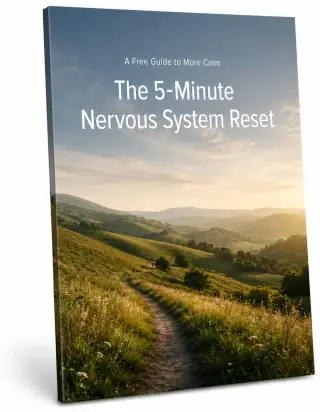
Want a few simple ways to tap the brakes on your nervous system, starting tonight? Our free 5-Minute Nervous System Reset guide walks you through five of them. No incense required.
Get the Free Guide →Questions
Frequently Asked Questions
Where to go from here
Who This Helps, and What to Explore Next
For anyone who’s been told “just stop worrying” and thought, wow, why didn’t I think of that. If you’re trying to sort out whether it’s your mind or your hardware, start here.

About the Author
Troy Gundersen
Troy is the co-founder and owner of Clear Mind Utah, a family-owned microcurrent neurofeedback center in American Fork, Utah. He and his wife Valerie opened the center after experiencing firsthand how a stuck nervous system can quietly take over, and how much is possible when it finally shifts. Troy works alongside Val and their daughter Sydni to help adults and families across Utah County find their way back to calm. Learn more about the team →
Clear Mind Utah · 21 E. 100 N., Ste. 101, American Fork, Utah · (385) 304-4434
Individual experiences vary. This technique is offered as general self-care information and is not a substitute for medical or mental health treatment. Clear Mind Utah provides microcurrent neurofeedback as a wellness and nervous system support service. We do not diagnose, treat, or cure any medical or mental health condition. If you are experiencing a mental health crisis, please contact a qualified professional or call or text 988 to reach the Suicide and Crisis Lifeline.