How to choose a neurofeedback provider in utah — clear mind utah, american fork | clear mind utah

Your Guide to Neurofeedback in Utah

How to Choose a Neurofeedback Provider in Utah

More providers. More options. More Googling at midnight. Here's how to cut through it.

Something happened to neurofeedback in Utah over the last few years.

It went from "what's that?" to "oh, I've heard of that" to approximately forty-seven providers showing up when you search for it — some standalone centers, some therapy offices that added it on a Tuesday, some using technology from a decade ago, some using something newer and very different.

Which is great, honestly. More access is a good thing.

But if you're the parent of a kid who can't sit still, or the adult who hasn't slept properly since 2021, or the person who has tried enough things that you're now researching neurofeedback at 11pm — you don't have time to interview everyone. You need to know what actually matters when choosing a provider.

So here it is. Six questions worth asking before you book with anyone — including us.

Question #1

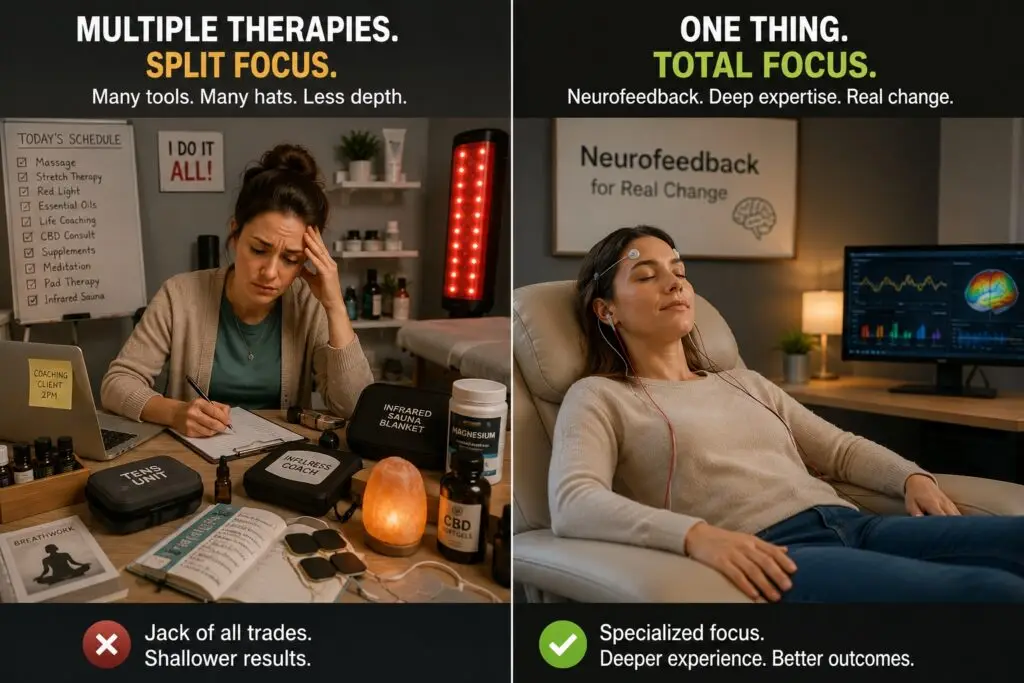
Do They Actually Specialize in This — or Is It Just on the Menu?

→ This one matters more than you'd think.

There's a version of neurofeedback that lives on a services page between "couples counseling" and "life coaching." It was added because a staff member got certified, or because it seemed like a natural fit, or because someone read an article about it.

And then there's a provider who built their entire center around it. Who does it every single day. Who has seen hundreds of nervous systems and knows what a typical response looks like, what an atypical one looks like, and what to do in either case.

These are not the same thing.

This isn't a knock on therapists or counselors who offer neurofeedback — some are excellent. But when you're deciding where to take your child, or where to invest your own time and money, it's a reasonable question: is this what they do, or is this something they also do?

A specialized center will usually have:

A higher session volume — meaning more collective experience reading how brains respond

Staff whose entire focus is the technology, not split between modalities

A clearer sense of what to expect, session by session, because they've seen the pattern hundreds of times

It's the difference between a restaurant that does one thing exceptionally well and a place with a menu the size of a novel. Both can feed you. Only one has spent years perfecting what's on your plate.

Question #2

Which Technology Are They Actually Using?
→ Not all neurofeedback is the same thing.
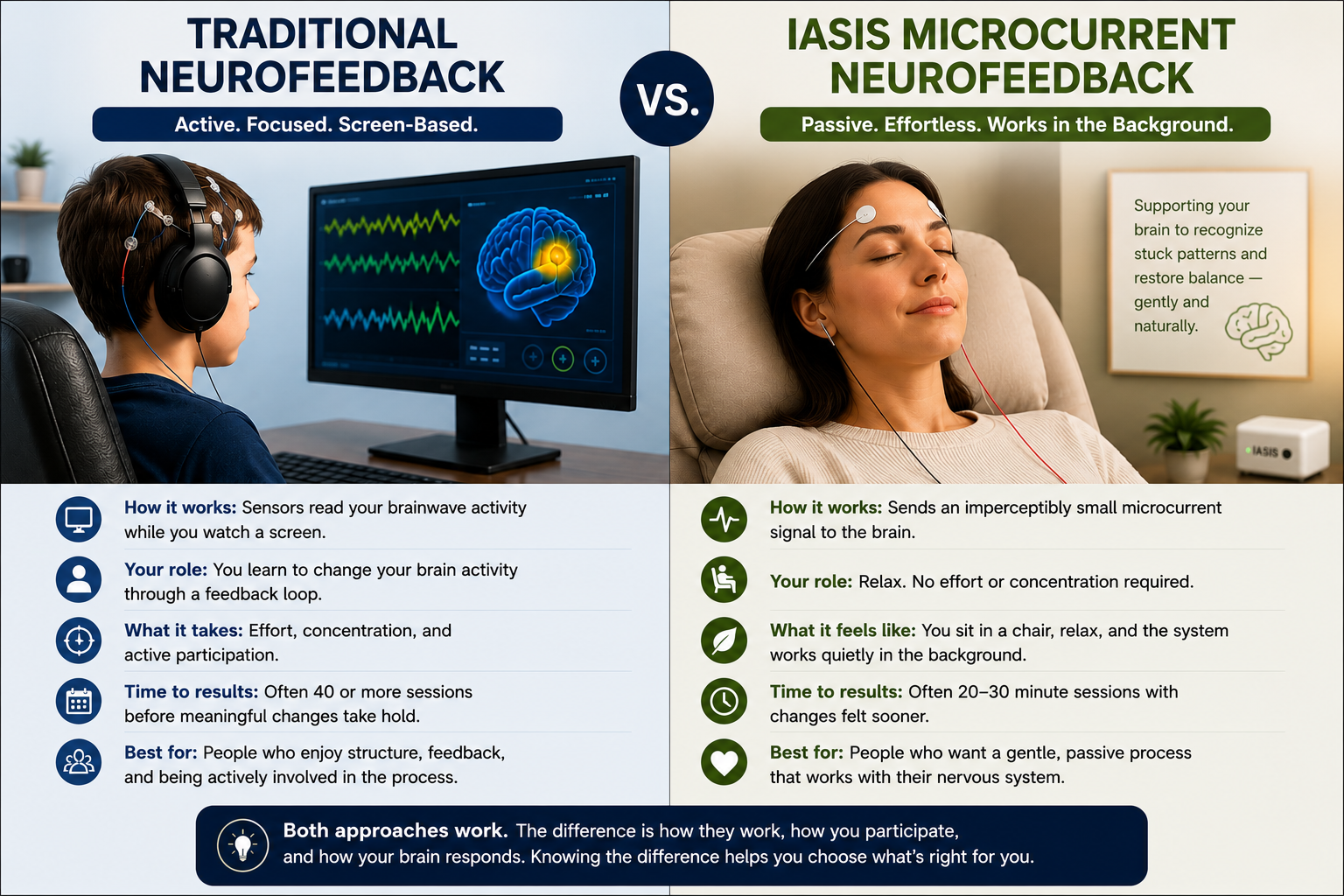
Traditional neurofeedback vs IASIS Microcurrent Neurofeedback — understanding the difference when choosing a provider in Utah

This is the part most provider websites skip — and it's one of the most important questions you can ask.

"Neurofeedback" is a category, not a single technology. It's a bit like asking someone if they do "physical therapy" — yes, but with what approach, what tools, and what philosophy?

There are two broad camps.

Traditional Neurofeedback

Involves watching a screen while sensors read your brainwave activity. Your brain learns to self-regulate through a feedback loop. It works — and it requires effort, concentration, and often 40 or more sessions before meaningful changes take hold.

Active participation
Screen-based
Longer sessions

IASIS Microcurrent Neurofeedback

Sends an imperceptibly small microcurrent signal that helps the brain recognize stuck patterns and reorganize itself. Nothing to watch. Nothing to concentrate on. You sit in a chair, relax, and the system works quietly in the background.

No effort required
Passive process
20–30 min sessions

Neither technology is magic. Both work with real nervous systems that respond differently. But knowing which one a provider uses — and why — tells you a lot about whether their approach matches what you're looking for. Here's a closer look at how this specific approach enhances calm and mental focus →

Question #3

Do They Work With Your Whole Family — or Just Part of It?

→ Worth asking before you assume.

Here's a scenario that plays out more than you'd think.

A parent spends two weeks researching neurofeedback for their twelve-year-old. They find a provider, book a consultation, drive across the valley — and find out in the waiting room that the practice primarily works with adults. The provider is lovely. The technology is solid. But they're not really set up for kids, and it shows.

Save yourself the trip. Ask upfront.

Neurofeedback is safe for children, teens, and adults — the technology itself doesn't discriminate by age. But not every provider is equally comfortable working with a seven-year-old who won't sit still, a fifteen-year-old who is skeptical about the whole thing, or a parent who needs someone to explain what's happening in plain language while their kid is in the chair.

A few things worth asking any provider:

"What's the youngest client you regularly work with?"

A provider who works comfortably with children will have a clear, confident answer.

"How do you handle kids who are anxious about the process?"

The answer tells you a lot about their experience level with younger nervous systems.

"Can parents be in the room?"

For younger children especially, this matters.

If you're a parent researching this for a child — or a family where multiple people might benefit — find a provider who treats the whole family, not just the demographic that's easiest to work with.

Question #4

What Actually Happens During a Session?
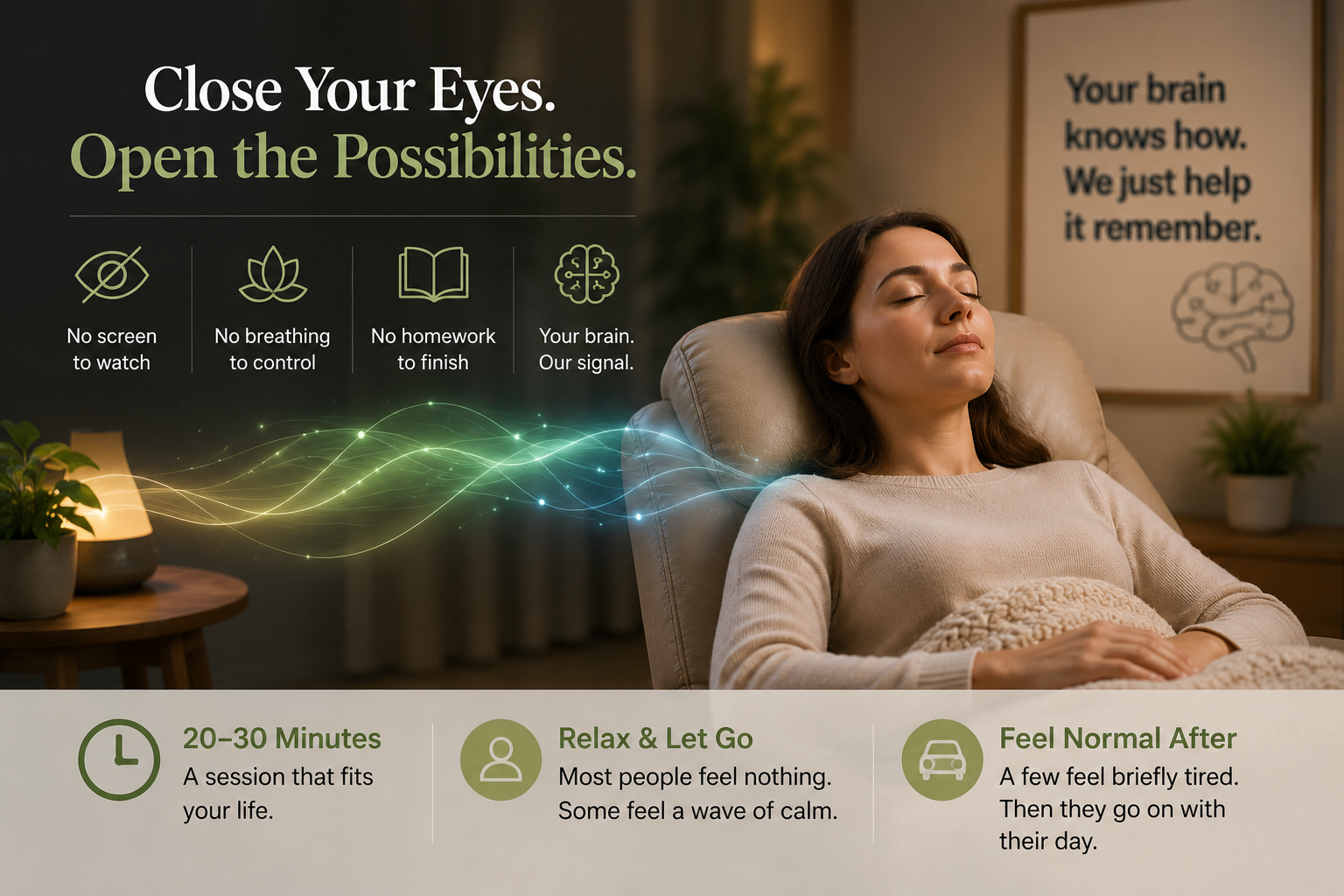
✓ Less weird than you're imagining. Promise.
Relaxing neurofeedback session at Clear Mind Utah in American Fork — nothing to do, just close your eyes

If you've never done neurofeedback before, the phrase "sensors on your scalp" does a lot of work in the imagination department. People picture something between a sci-fi movie and a visit to a neurologist who takes himself very seriously.

It's neither.

Here's what actually happens. You sit in a comfortable chair. Small sensors are placed gently on specific points on your scalp — no gel, no shaving, no wincing. They read your brain's electrical activity and deliver an imperceptibly small microcurrent signal in response. Most people feel absolutely nothing. Some notice a mild wave of relaxation. A few feel briefly tired afterward, which usually passes before they've made it to their car.

The whole thing takes about 20 to 30 minutes.

"There is nothing to do. No screen to watch. No breathing pattern to concentrate on. No homework. You can close your eyes, think about what you're making for dinner, or mentally rewrite an awkward conversation from 2019. The system works either way."

For people with anxiety or an overactive mind, that tends to be the most surprising and welcome part of the whole experience.

When vetting a provider, ask them:

"Do I need to do anything during the session?" If the answer involves effort or concentration, that's traditional neurofeedback — which is fine, but different from what we've been describing.

"How long is a session?" Shorter with IASIS, longer with traditional. Matters when you're fitting this around school pickups and work schedules.

"What might I feel afterward?" A provider with real experience will give you a specific, honest answer. Vague enthusiasm is a yellow flag.

A good first session doesn't need to change your life. It just needs to make you want to come back for the second one.

Question #5

What Are Real Clients Actually Saying?

→ Reviews tell you more than any brochure ever will.

Every neurofeedback provider in Utah has a website that says some version of the same thing. Gentle. Non-invasive. Life-changing. Drug-free. Transformative.

Websites are written by people who want you to book an appointment. Reviews are written by people who already did. That's the difference.

Specificity beats enthusiasm

"It changed my life!!!" tells you someone felt strongly. "My daughter went from three meltdowns a day to maybe one a week, and she's sleeping through the night for the first time in two years" tells you something actually happened. Look for the specific ones — they're harder to fake and more useful to you.

Don't read too much into the number of reviews

Neurofeedback attracts people who are private by nature — many of the same people who took months to tell anyone they were even trying it. A provider with fewer reviews but deeply specific ones often tells a more honest story than a provider with a hundred generic five-stars. The content matters more than the count.

Look for your situation in the reviews

If you're coming in for sleep, find reviews from people who came in for sleep. If you're bringing a teenager, find reviews from parents of teenagers. The best providers tend to attract the same kinds of clients over and over — and the reviews show it.

Awards are a supporting signal, not the whole story

Independent recognition from legitimate organizations means someone outside the practice took a look and said something worth saying. It's not a guarantee of anything — but it's better than nothing, especially when it's happened more than once.

What you're building, across reviews and recognition, is a picture of consistency. Not perfection. Consistency. A provider who reliably helps people who look like you, with problems that sound like yours, over a sustained period of time. That's the one worth booking with.

Question #6

Is the Pricing Clear Before You Commit to Anything?

→ Vague pricing is a yellow flag. Trust your instincts.

Neurofeedback is an investment. Anyone telling you otherwise is either leaving something out or trying to get you in the door before you do the math.

The question isn't whether it costs money. It does. The question is whether a provider is upfront about what that looks like — before you've driven across the valley, sat through a consultation, and started to feel hopeful.

Here's what pricing transparency looks like at a provider worth trusting:

You can find the numbers before you call

A provider who publishes their session rates and package pricing on their website isn't hiding anything. If you have to book a consultation just to find out what things cost, that's a sales funnel, not a service.

They explain the package logic without pressure

Most providers offer single sessions and multi-session packages. A good provider explains why packages exist — nervous system change tends to happen over a series of sessions, not a single visit — without making you feel like you're being upsold before you've even started.

They tell you about financing and HSA/FSA upfront

For many families, the per-session cost is manageable but the package total feels like a stretch. Providers who offer financing options or accept HSA and FSA cards — and tell you about it without being asked — are making a good-faith effort to make this accessible.

There's no pressure to commit before you're ready

A free consultation should feel like a conversation, not a closing. If you leave feeling like you were nudged toward a decision before you were ready, that's information.

The providers worth working with understand that trust comes before commitment — and that someone who feels respected during the process is far more likely to complete their sessions, refer their friends, and actually get the results everyone is hoping for.

If You're in Utah County

Here's Where That Search Gets Easier

We'll be straight with you — we're Clear Mind Utah, and we're based in American Fork. So we have an obvious interest in what comes next.

But here's the thing: everything in this guide applies to us too. We'd rather you hold us to these same six questions than take our word for it. So let's run the list.

Do we specialize?

Yes. IASIS Microcurrent Neurofeedback is all we do. Not one service among a dozen — the only thing on the menu.

Which technology do we use?

IASIS Microcurrent Neurofeedback — the passive, no-effort approach described in Question 2. No screens, no tasks, no concentration required.

Do we work with the whole family?

Yes. Adults, teens, and children of all ages. We work with kids regularly and we know how to make the experience comfortable for someone who would rather be anywhere else.

What does a session look like?

Comfortable chair. Small sensors. Twenty to thirty minutes. Nothing to do. Many clients describe it as the most relaxed they've felt in years — which, for someone dealing with anxiety or chronic stress, is either wonderful or deeply suspicious. Usually both, at first.

What are clients saying?

We'll let them speak for themselves. Read our reviews →

Is our pricing clear?

Yes. Single sessions are $150. Our most popular package — the Complete 20 — is $2,299. Financing is available through Advance Care Card at 0% interest for qualified clients. HSA and FSA cards are accepted in most cases. No surprises. View full pricing →

We've been independently recognized as the Best Neurofeedback Provider in Utah three years running — 2024, 2025, and 2026. We're proud of that. We're more proud of the reviews.

If the answers above feel like the right fit, we'd love to talk. If they don't — we hope this guide helped you find someone who is.

No referral needed. No pressure.

Ready to Ask Us These Questions in Person?

That's what the free consultation is for.

Thirty minutes. No obligation. No expectation that you've made up your mind before you walk in. Just a conversation about where you are, what you've tried, and whether what we do might be a good fit for you or your family. Most people leave with a clear answer either way — and that's exactly the point.

Book a Free Consultation →

Or call or text us directly at (385) 304-4434.

Related pages worth reading:

Individual experiences vary. Clear Mind Utah provides IASIS Microcurrent Neurofeedback as a wellness and nervous system support service. We do not diagnose, treat, or cure any medical condition. Located at 21 E. 100 N. Ste. 101, American Fork, UT 84003.

Troy Gundersen, owner of Clear Mind Utah

About the Author

Troy Gundersen

Troy is the co-founder and owner of Clear Mind Utah, a family-owned IASIS Microcurrent Neurofeedback center in American Fork, Utah. He and his wife Valerie opened the center after experiencing firsthand how a stuck nervous system can quietly take over — and how much is possible when it finally shifts. Troy works alongside Val and their daughter Sydni to help adults and families across Utah County find their way back to calm. Learn more about the team →


IASIS MCN Practitioner
American Fork, Utah
Family-Owned Center
author avatar
Troy Gundersen

Featured Articles

FREE PDF GUIDE
The 5-Minute Nervous System Reset free guide cover

The 5-Minute Nervous System Reset

Four fast, evidence-informed techniques you can use the moment stress hits — no equipment, no appointment. Get it free, straight to your inbox.

Get the Free Guide →

No spam. Unsubscribe anytime.

BY TROY & VALERIE GUNDERSEN
Overcome Fear book by Troy and Valerie Gundersen

Overcome Fear

Real tools for moving through self-doubt and the fear of the unknown — from the founders of Clear Mind Utah.

Get It on Amazon →
Find-Us-Here.com - the world's largest business and community directory covering Australia, Canada, New Zealand, United Kingdom and United States